PEMBERDAYAAN PEREMPUAN MELALUI PEMANFAATAN PEKARANGAN MENGGUNAKAN LIMBAH DAPUR SEBAGAI PUPUK ORGANIK DI JEMAAT RANTE TAGARI KLASIS TALLUNGLIPU
DOI:
https://doi.org/10.53067/icjcs.v6i2.248Keywords:
Women's Empowerment, PWGT, Kitchen Waste, Liquid Organic Fertilizer, Home Yard Utilization, Household Food Security.Abstract
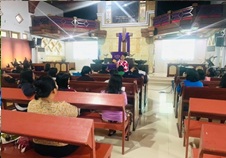
Household organic waste remains an environmental challenge that has not been optimally managed by many communities. At the same time, home yards possess significant potential to support household food security when utilized productively. This community service program aimed to enhance community knowledge and skills in processing kitchen waste into liquid organic fertilizer and optimizing home yard utilization for vegetable cultivation. The target participants were 302 members of the Women's Fellowship of Toraja Church (Persekutuan Wanita Gereja Toraja/PWGT) at Rante Tagari Congregation, Tallunglipu Classis. This group was selected because of its strategic role in household management, including food preparation, kitchen waste management, and home yard utilization. The program was conducted over a three-month period through observation, socialization, training, demonstration, mentoring, and evaluation activities. The results indicated an improvement in participants' knowledge and skills in producing liquid organic fertilizer from household kitchen waste. Participants were able to independently produce and apply organic fertilizer to vegetables cultivated in their home yards. During the mentoring period, various vegetables, including mustard greens, spinach, kale, tomatoes, eggplants, and chili peppers, showed good growth and were utilized for household consumption. In addition to improving yard productivity, the program encouraged positive behavioral changes in household waste management, reduced dependence on inorganic fertilizers, and increased environmental awareness. The findings demonstrate that women's empowerment through the utilization of kitchen waste and home yards can contribute to household food security while promoting a cleaner, greener, and more sustainable environment.
Downloads
References
Adriadi, A., Asra, R., Ihsan, M., Wulandari, T., Sazali, A., & Wahyuni, F. (2025). Innovation of household organic waste utilization into eco enzyme and liquid organic fertilizer. Dinamisia: Jurnal Pengabdian Kepada Masyarakat, 10(1). https://doi.org/10.31849/dinamisia.v10i1.30964
Essilfie, G., Sebu, J., & Baako-Amponsah, J. (2024). Does women’s empowerment matter for household food security? Evidence from Northern Ghana. SAGE Open, 14(2). https://doi.org/10.1177/21582440241245076
Food and Agriculture Organization. (2024). The state of food security and nutrition in the world 2024. FAO.
Haque, S., Salman, M., Hasan, M. M., Prithi, A. A., & Hossain, M. E. (2024). Women’s empowerment and its role in household food security to achieve SDGs: Empirical evidence from rural Bangladesh. Sustainable Development, 32(4), 4297–4314. https://doi.org/10.1002/sd.2893
Harlianingtyas, I., Jumiatun, & Pertami, R. R. D. (2025). Pemberdayaan perempuan melalui pelatihan pengolahan limbah rumah tangga menjadi pupuk organik cair. J-Dinamika: Jurnal Pengabdian Masyarakat.
Haryanto, Y., Hartono, R., & Wibowo, H. T. (2023). Rural community empowerment through the utilization of straw as compost. Universal Journal of Agricultural Research, 11(1), 202–207. https://doi.org/10.13189/ujar.2023.110120
Husna, A. R., Willianarti, P. F., Putri, I. D., & Az-Zahra, R. N. (2023). Community empowerment: Processing household organic waste into compost using the Takakura technique. Journal of Community Empowerment for Multidisciplinary, 1(1), 49–55. https://doi.org/10.53713/jcemty.v1i1.76
Jemaneh, S. A., & Shibeshi, E. M. (2023). Women empowerment in agriculture and its effect on household food security: Evidence from Gamo Zone of Southern Ethiopia. Agriculture & Food Security, 12(37). https://doi.org/10.1186/s40066-023-00437-1
Khairani, L., & Nabiu, M. (2023). Pemberdayaan Kelompok Wanita Tani melalui pelatihan pembuatan pupuk organik cair menggunakan bioaktivator. Jurnal Pengabdian kepada Masyarakat Dewantara, 6(1), 21–29. https://doi.org/10.31317/jpmd.v6i1.845
Marlinda, M., Nadir, M., Faisal, F., Purwanto, M. W. D., & Putri, D. P. (2023). Education on the use of organic waste to become environmentally friendly orozeco (organic fertilizer and eco enzyme). Community Empowerment, 8(4), 540–545. https://doi.org/10.31603/ce.8492
Mirasari, R., Rahman, A., Anwar, R., & Marlendi, S. (2024). Pemberdayaan ibu rumah tangga dalam pemanfaatan limbah rumah tangga metode Takakura untuk mendukung rumah pangan lestari. Pengabdian Kampus: Jurnal Informasi Kegiatan Pengabdian Pada Masyarakat, 10(2). https://doi.org/10.52850/jpmupr.v10i2.11446
Nuryati. (2024). Pemanfaatan limbah organik rumah tangga sebagai pupuk organik untuk mendukung budidaya tanaman dan pengelolaan lingkungan berkelanjutan.
(Catatan: data jurnal/penerbit/DOI belum tersedia—perlu dilengkapi sesuai sumber asli).
Rahmawati, D., & Suryani, E. (2025). Pendekatan partisipatif dalam pemberdayaan masyarakat berbasis lingkungan. Jurnal Pengabdian Masyarakat Berkelanjutan, 6(1), 11–20. https://doi.org/10.56789/jpmb.v6i1.2025
Sari, T. P., & Basmantra, I. N. (2023). Pemanfaatan sampah organik rumah tangga menjadi eco enzyme dalam upaya pemberdayaan ekonomi masyarakat. Vivabio: Jurnal Pengabdian Multidisiplin, 5(2). https://doi.org/10.35799/vivabio.v5i2.46516
Suwali, S., Mahendra, B., Saputra, L. A., Riyanto, A. B., Priambodo, A., & Sulaeman, M. (2022). Pemanfaatan limbah rumah tangga dan dedaunan menjadi pupuk organik cair pada anggota PKK. Perwira Journal of Community Development, 2(2). https://doi.org/10.54199/pjcd.v2i2.128
UN Women. (2023). Progress on the sustainable development goals: The gender snapshot 2023. United Nations.
Yuliana, S., & Putra, A. (2024). Optimalisasi pemanfaatan pekarangan rumah untuk mendukung ketahanan pangan keluarga. Jurnal Pengembangan Masyarakat, 8(2), 77–86. https://doi.org/10.23456/jpm.v8i2.2024
Downloads
Published
How to Cite
Issue
Section
License
Copyright (c) 2026 Driyunitha, Yulius Pakiding, Sion Oktafianus, Ernytha A Galla

This work is licensed under a Creative Commons Attribution-NonCommercial-ShareAlike 4.0 International License.